
Dear England: Your Wetherspoons are…. crazy

Wetherspoons is usually a last resort for me. I don’t drink much anymore, and when I do go out, I’d rather support a small independent pub or a local microbrewery. Looking at some of the buildings the chain uses, though, gave me something else to appreciate.
An old cinema, an opera house, a former bank and an enormous orangery aren’t what I immediately picture when someone says Spoons. I’m a Canadian living in Kent, and this kind of architecture and history is part of what I love about the UK. I can admire a building without suddenly wanting to eat there.
Watch my Wetherspoons buildings reactions on YouTube.
An opera house in my county
I started with a list of unusual Wetherspoons locations. The Palladium in Llandudno was described as a former cinema, and I thought its front looked gorgeous. I didn’t know exactly what it had looked like originally, but I appreciated the appearance of the building I was seeing.
Then the list reached the Opera House in Tunbridge Wells. Kent mentioned already. The account said that the pub returned to opera performances for a short period each year, which I found hard to imagine. It was a Spoons, but also still an opera house?
Those were places I was looking at through articles and photographs, rather than reporting on a pub crawl. Even so, the contrast interested me. I expect Wetherspoons to offer something cheap and predictable. A former opera house wasn’t part of that expectation.
The Counting House in Glasgow made the same point in a different way. The list described it as a former Bank of Scotland building, and I thought it looked like an extravagant bank once that connection was mentioned. It certainly didn’t look like my Lloyd’s branch.
Giving an old place another job
The North Western in Liverpool was another example that appealed to me. The account identified it as a former hotel at Lime Street station, and I loved the architecture. That was exactly the sort of building I meant when I talked about loving the history here.
I appreciate old places getting another use rather than being torn down. What do you do with a building once its previous job is over? Seeing it given a second life appeals to me, even when that next life is a chain pub I wouldn’t normally choose.
The Chief Justice of the Common Pleas in Keswick took that idea somewhere stranger. The list described a renovated magistrates’ court and police station, with drinks served in former cells. I thought that sounded fun. The name itself seemed a challenge for someone trying to tell a taxi driver where to pick them up after a night out.
Exeter had the window
Later I found photographs of the Imperial in Exeter. The account described its earlier life as a hotel, and the barrel-vaulted orangery was the detail that stood out. The old building, that interior and the enormous window made me wonder whether this was the fanciest Wetherspoons I’d seen in my search.
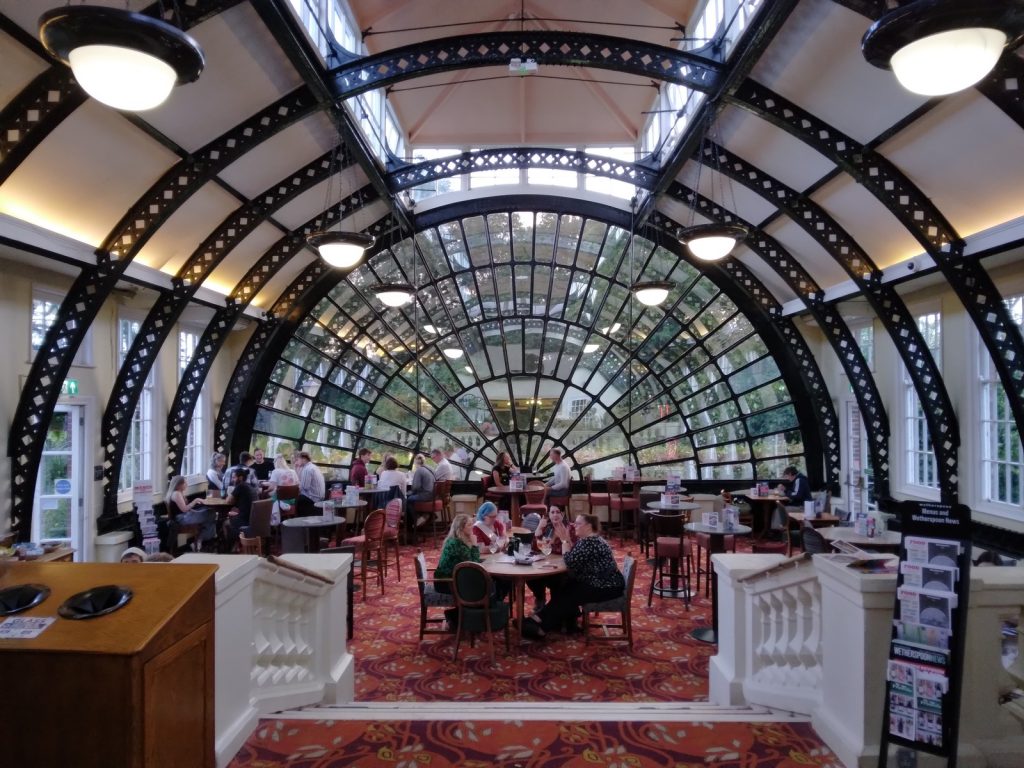
Some of the earlier examples had mostly shown me their exteriors. Here, the inside made just as much of an impression. Imagining someone sitting in front of that giant window with an ordinary pint and breakfast was a very funny contrast.
I kept coming back to the sticky-carpet joke throughout the search. A grand building doesn’t stop it being a Wetherspoons. But it was hard to deny how much I liked this particular space.
I still prefer the independent pub
I’ve eaten at Wetherspoons before, and I’m not looking to do it again. I understand why someone wants a cheap, familiar meal, but when I’m spending money on food I’d rather put it into a small local place.
There’s a situation where Spoons makes sense to me. If I’m with a larger group and the independent pubs or microbreweries haven’t got room, it becomes an option. I know what I’m getting.
The buildings added another reason to be interested. I still wanted to support the local pub, but I loved seeing a cinema, bank, hotel or courtroom have another life. The Imperial’s enormous window was particularly hard to argue with.





No Comments