
Canadian things that totally shocked my British partner

Taking my British partner to Ontario in summer 2024 gave me a fresh list of things I’d never thought to explain about home. We were visiting my family, which I try to do once a year, and some of the things that surprised him were so ordinary to me that his reaction was the interesting part.
The animals were a good example. In my family’s back garden we saw squirrels, frogs, chipmunks, a fox, raccoons, deer, moths and rabbits. This wasn’t a cabin miles from civilisation. They live in a fairly densely populated area. I was used to seeing wildlife there, but he was surprised by how much of it turned up around the house.
Home looks different when someone else visits
People sometimes hear Canada and picture moose and polar bears. I’m from southern Ontario, and I’ve never seen either there. The animals in the garden were the ones I recognised from growing up. Seeing his reaction made me realise how much I’d taken them for granted, especially after living in England.
Flagpoles outside people’s houses were another surprise. I don’t mean flags outside government buildings, but ordinary homes with a Canadian flag flying out front. My family never had one. When I was younger, I thought they were cheesy because, well, we knew which country we were in. Why did we need a reminder on the lawn?
My dad used to joke that I’d come home from school one day and find a flagpole outside our house. I wouldn’t have been happy about that. My view has changed since then, though. I can understand someone wanting to show pride in where they live, even if my younger self would have rolled her eyes at the idea.
The roadside billboards stood out to my partner too, especially adverts for realtors. He said he didn’t really see those in England. I remembered them from childhood, so they didn’t strike me as unusual. I also remembered our drives down to Florida, where the billboards seemed even more common. His visit kept turning familiar scenery into something worth talking about.
A friendly cashier and a box for dinner
He noticed how friendly people were in shops, bars and restaurants. That matched what I enjoyed about being back. I’ve heard British people describe that sort of friendliness as fake, or point out that someone is being paid to be nice. I know that argument. I still like a positive exchange when I’m buying something.
I’ve had occasions in the UK when I’ve felt unwelcome as a customer, and I prefer walking into a place where the person seems pleased to help. I’m talking about our experiences on this trip, though. It would be ridiculous to turn a holiday’s worth of conversations into a rule about every person in either country.
Taking restaurant leftovers home was another very normal part of the visit. The portions were often big enough that we couldn’t finish them, and servers would offer a container. To me, putting the rest in a box and eating it later made sense. My partner was surprised by how routine it seemed.
I’ve never asked to take leftovers home in the UK because I feel awkward about it. That doesn’t mean you can’t. I’m describing my own hesitation, compared with sitting in a Canadian restaurant and having someone offer before I’d even asked. It’s an especially useful difference when you’ve ordered more food than you can manage.
Then someone dropped a glass in a restaurant, and nobody cheered. We just carried on with what we were doing. After years in Britain, the lack of a reaction felt noticeable to me. I wouldn’t claim cheering never happens in Canada, especially in a dive bar, but this was one of those moments where the British response had become familiar enough for its absence to stand out.
Yes, the milk really comes in a bag
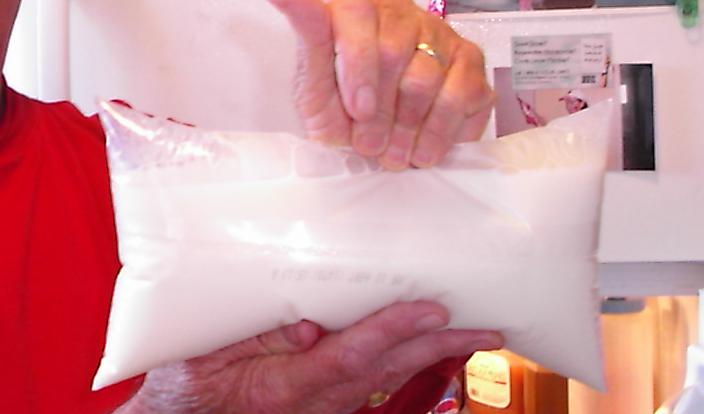
Bagged milk needs explaining every time. It isn’t something everyone across Canada uses, but it’s normal where my family lives in Ontario. We would buy a larger bag containing three smaller bags of milk, then put one of those smaller bags into a reusable jug. In homes like mine, the same jug can be around for decades.
You snip a corner off the bag, on the opposite side from the jug’s handle, and pour. When that bag is empty, you take it out and put the next one in. People imagine leaks or a milk explosion, but I’ve never had either happen. For me, it was just the way milk worked at home. For my British partner, it was another surprising difference.




Francisco
I’ve been to Canada twice: Stayed in a youth hostel in Ottawa. Years later, I was seeing someone who had relations in the Toronto area so spent a week or two in the area:
My observations are:
* Airlines really do lose luggage (thought that that was just a myth)
* Smog does exist (thought that it was just an effect that American filmmakers and TV studios used to make things look more dramatic)
* The slit type plug sockets you see in cartoons are real
* The current limit is similar to Europe so the power provided by said sockets is less (Power = Voltage x Current)
* Sales tax isn’t included in the price
* Mugging is something you have to take seriously (luckily didn’t get mugged but buying clothes whilst waiting for the airline to deliver my luggage I overheard the staff discussing what they would do if they were mugged at gun point)
* Streets are very long
* The Canadian Parliament is clearly modelled on the UK one and the Canadian Head of State is the monarch of the UK
* Buses are used more than trains for long distance travel
* Taxis are expensive (the one time I used one the meter was spinning so fast it looked more like a stopwatch than a taxi meter)
* Had to go to a drug store to get something that I would go to a different kind of shop here to get. I can’t remember what.
* Some vehicles are really big (I think that on a minor road trip I was the vehicles that were working a quarry)
* It gets very hot in the summer (thought weather would be closer to Europe, eg Germany)
* Ice wine is a thing
Francisco
I forgot:
* The Greater Toronto Area includes cities.
* In the suburbs,, pedestrians are made to feel like an afterthought.