
SOLO TRIP to Britain’s Imperial War Museum

I’d been to the Imperial War Museum before, but never to a museum on my own. Going alone was the new part. I admired people who could go out and do things by themselves without feeling anxious or embarrassed, and I wanted to get more comfortable doing that too.
This museum had a particular connection to my move. I remembered first visiting in November 2015, when I’d gone into London to collect a visa permit and stopped there with my partner. Returning years later, with my life so different and England still my home, felt a bit strange. When I first arrived, I hadn’t known whether I’d stay or go back to Canada within a year.
An expensive journey to a free museum
I took the train and the Tube into London. It was a long journey and the train was busy, although the air conditioning was working, which was bliss on such a hot day. Transport wasn’t cheap, but being able to get to a museum like this on public transport still felt pretty special.
The museum collections were free to enter on this visit, which always surprises me as a Canadian. I’d looked up the Royal Ontario Museum in Toronto and found that a family outing there would mean paying for each person. My train had cost money, but once I reached the Imperial War Museum I could spend the day exploring without an entry ticket.
I also loved the way the museum was laid out. I started with the First World War galleries and moved onwards through the periods as I went up through the building. There was an enormous amount to read, and at first all the plaques and objects felt a little overwhelming.
The soldiers’ personal things were my favourite
The items I found most interesting were the personal belongings, including journals with people’s handwriting, photographs and the things individual soldiers had kept. The galleries had weapons and uniforms too, but those smaller personal details were what I particularly liked looking at.
There were references to Canada and Canadian soldiers, which caught my attention, especially when I spotted Ontario mentioned. Another object that stayed with me was a leather glove described in the display as having shrunk because of poison gas. It looked about the size of a child’s glove, and I’d never really thought about what happened to the soldiers’ equipment as well as to the people themselves.
Schoolchildren were moving through the galleries while I was there, so it was busy, but I could still see the objects and read the displays. When I had extra time later, I could go back through quieter sections. The amount of material made this somewhere I could spend a long time in one exhibition.
The Second World War felt close to home
The Second World War galleries included civilian life as well as fighting. There was a recreated home and a shelter, and objects such as a children’s gas mask. I sometimes think of these events as distant history, but my grandfather fought on D-Day. That gives me a much closer family connection than the word history can suggest.
I couldn’t comprehend what that experience must have been like for him as a young man. Looking at the civilian exhibits was another reminder of how much there was to understand beyond the battles. I thought the whole floor was really well done.
By then I was tired and hungry, so I went downstairs to the cafe despite not usually liking museum cafeterias. It was busy and I panic-ordered a chicken Caesar ciabatta, assuming that would be hard to get wrong. It cost £7.50 that day, and I wasn’t impressed with what I got. An excellent museum visit did not make that sandwich a good purchase.
A difficult gallery I was glad I visited
I didn’t film the Holocaust gallery, and I wouldn’t have wanted to. It was very blunt about what had happened, with photographs and material that made me cry. I found it heavy and tough to go through, but also important and very well done.
Afterwards, I wandered around the larger vehicles and machinery displayed outside the main galleries. One large bomber section let me look inside, with art on its exterior too. By this stage I was worn out emotionally as well as physically, but there was still so much to see.
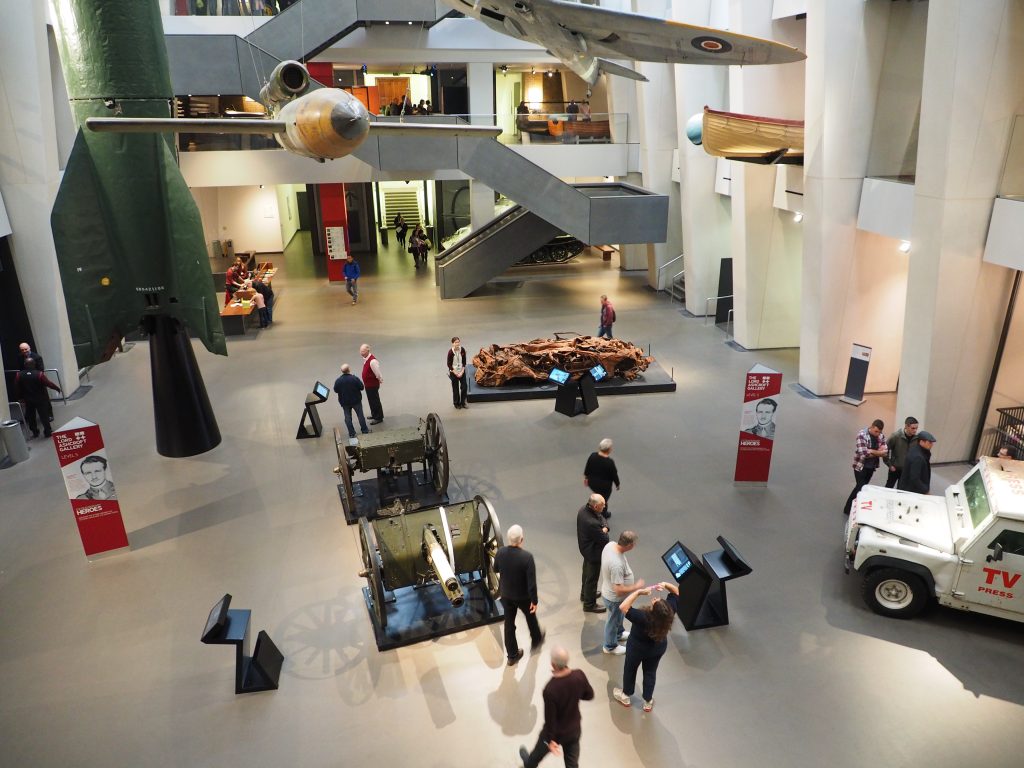
I wouldn’t describe the day simply as fun, given what the exhibits were about. Enlightening was a better word. It had also been a successful first solo museum adventure, and I was glad I’d done it. The First World War galleries were probably my favourite, partly because I feel I see much more about the Second World War in films and television, and there was so much here that I didn’t know.





No Comments