
How Britain Won the War… with Monopoly

My usual kitchen research involves eating British crisps. This time I ended up learning about Monopoly boards made to conceal escape equipment during the Second World War. When I first came across the story online, I thought it might be fake. I looked into it and was so surprised that I wanted to share it.
The part that caught me was the ordinary object at the centre of it. I knew Monopoly as a childhood game that could bring out my terrible losing habits. I hadn’t known about its use in helping prisoners of war. My March 2024 video took that familiar board game somewhere I hadn’t expected.
A familiar game with unfamiliar streets
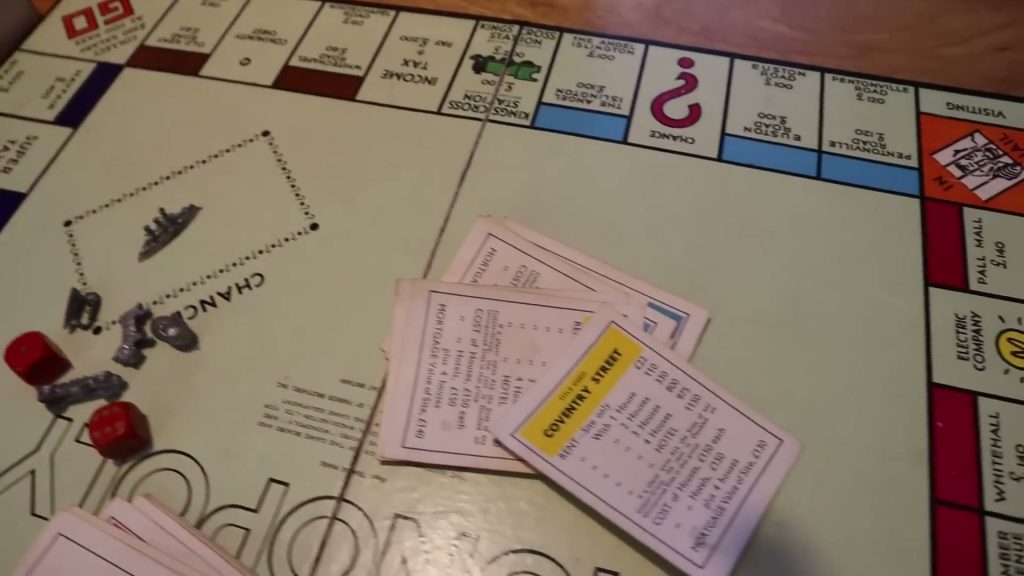
I bought an old Monopoly set on eBay from someone in Edinburgh so I could look at a British version while talking about the story. I couldn’t tell exactly what year it came from. Its artwork clearly wasn’t recent, but buying a vintage game didn’t establish that I had a wartime escape board. My set was there to help show the game itself.
The board I played on growing up in Canada was an American version, with dollars and American place names. I asked my sister to film our old family set for the comparison. It was a bit beaten up, and it was the version I remembered from childhood. I wasn’t claiming every Canadian household used the same one.
Looking through the British set was fun. Regent Street, Oxford Street and Bond Street were different from the names I knew. I went looking for my usual tokens, the cannon or top hat, and neither seemed to be there. I settled on the ship. I also had to apologise to the friends and family who’ve played with me, because I really am not a good loser.
Equipment hidden inside a board
Before this story, I’d heard of MI5 and MI6, but not MI9. The National Archives describes MI9 as the secret government organisation that helped military personnel evade capture and escape captivity. Its work included providing concealed escape aids and maps. That gave me the context for why someone would think about altering an apparently ordinary game.
Leeds Museums and Galleries’ account on MyLearning describes Christopher Clayton Hutton working with Waddingtons in 1941 to hide escape kits in Monopoly boards. The equipment included silk maps, miniature compasses, metal files and real money. The game became a way to conceal useful things, rather than the means of escape on its own.
The silk maps were the detail I found particularly clever. They could fold into a small space and cope better with water and handling than paper. They also wouldn’t rustle in the same way when unfolded. I had started by thinking a map was an obvious thing someone would need; I hadn’t thought about the practical trouble a paper one could cause.
The other items answered more of those practical questions. A compass could help with navigation, a file with getting through a barrier, and real currency with buying supplies after getting out. Those were the uses I talked through in the video. Getting beyond the camp wasn’t the same as having everything you needed afterwards.
Getting the right map to the right place
The museum account describes fake charities sending the modified boards to prisoner-of-war camps. It also explains marks that identified the maps inside them. A full stop after Marylebone Station indicated Italy; one after Mayfair indicated Norway, Sweden and Germany. Even punctuation on a familiar board could have a separate purpose.
That doesn’t mean all old Monopoly sets were altered. It also doesn’t give me a reliable total of prisoners who escaped because of them. I acknowledged that uncertainty in the video, and I wouldn’t turn a story about escape aids into a claim that one board game won the war. The interesting part is the specific work of concealing and delivering the equipment.
I love learning things about my second home that I hadn’t come across before. This one surprised me enough to interrupt the usual food testing, buy a vintage board and get thoroughly distracted by the pieces. I thought the ingenuity was brilliant. My ordinary family Monopoly arguments now had some very unexpected historical company.




No Comments